The art works of Clément Bagot are combining large and micro scale. In fact, the distance between the observer and the art piece define the size of the worlds that Bagot is creating. In the one hand he's producing huge drawing like cartography or large scale microscopic views and in the other hand he's crafting impressiv models of citys, tower, floating islands. All of those are higly detailed and made of paper, cardboard, wood and plexiglas.
lundi 23 novembre 2009
# The utopian cities of Clément Bagot
The art works of Clément Bagot are combining large and micro scale. In fact, the distance between the observer and the art piece define the size of the worlds that Bagot is creating. In the one hand he's producing huge drawing like cartography or large scale microscopic views and in the other hand he's crafting impressiv models of citys, tower, floating islands. All of those are higly detailed and made of paper, cardboard, wood and plexiglas.
mercredi 1 juillet 2009
# SEA /// Architectural wrecks
I really like the timeless aspect of those ships waitng their slow destruction by outside elements.
They looks like ruins in a desert, with no real scale ... just amazing!
mardi 13 janvier 2009
# SELF-CONSTRUCTION /// Ice as a building material
Building an igloo is a very interesting concept of using one material, the ice, and building a close space without any transformation of the material, any nails or glue, just ice!
This free material had already inspired some architects that desiged some cool pavillion for the Snow Show. I supposed that they were not part of the building team (if that ever happened) !

Tadao Ando @ the snow show
Zaha Hadid @the Snow show
# SELF-CONSTRUCTION /// Tungkwan
Dwellings below, fields upstairs
The photographs show settlements of the most rigorous, not to say abstract, design near Tungkwan (Honnan). The dark squares in the flat landscape are pits an eighth of an acre in an area, or about the size of a tennis court. Their vertical sides are 25 to 30 feet high. L-shaped staircases lead to the apartmments below whose rooms are about 30 feet deep and 15 feet wide, and measure about 15 feet to the top of the vaulted ceiling. They are lighted and aired by openings that give onto the courtyard. "One may see smoke curling up from the fields" writes George B. Cressey in his Land of the 500 million: A geography of China, even though there is no house in sight; "such land does double duty, with dwellings below and fields upstairs." The dwellings are clean and free of vermin, warm in winter and cool in summer. Not only habitations but factories, schools, hotels and goverment offices are built entirely underground.

dimanche 11 janvier 2009
# SELF-CONSTRUCTION /// I.A.A.C. 2nd Advanced Architecture Contest
Awarded projects:
1st Prize: F1C243
Ming Tang
Dihua Yang
CHINA
This proposal uses a traditional local material, implementing geometry elements in a pertinent way creating structures able to transform and re-inform themselves . The jury values its landscape integration and the possibility of being constructed as prototype.
2nd Prize: 5923BC
Luis Aguirre Manso
SPAIN
The jury values the hybridisation of light construction systems that rise from the ground, and the
functional scheme surrounding the chimney, that follows principles of traditional architecture.
3rd Prize: C2BD4E
Shinya OKUDA
Kung Yick Ho Alvin
Lam Yan Yu Ian
HONG KONG
The jury values the use of advanced technologies in the manipulation of biodegradable materials to create a system that can be assembled as a sustainable construction.
1st prize:
2nd prize:
you can see better picture of the second prize wich is for me the most interesting : here
3rd prize:
samedi 10 janvier 2009
# SELF-CONSTRUCTION /// Robert Neuwirth's shadow cities
One of self-construction's motivation comes from the fact that it is difficult for the authority to control and thus, sometimes its illegal existence for a more or less important time. That is one of the topics tackled by Robert Neuwirth in his book, Shadow cities. A billion squatters, a new urban world. In fact, for his research, this author lived for a while in one of Rio's favelas and other illegal district in Nairobi (Kenya), Mumbai (India) and Istanbul (Turkey). For each city, he is interested in observing how these districts' inhabitants manage to negociate with their environment's illegal existence thanks to a bypass or an interpretation of the law, which allow their juridical eviction to be more difficult. That is how we learn that, a Turkish law affirms that an illegal building in construction can be destroyed immediately whereas, an achieved building could only be demolished after judiciary proceedings. Therefore a lot of buildings are built very quickly during the night, to limitate as possible the vulnerability period. It is then interesting to observe how the bypass of law influence architecture and become a collective tacit knowledge which rules the district organisation.vendredi 9 janvier 2009
# SELF-CONSTRUCTION /// Straw as a building material
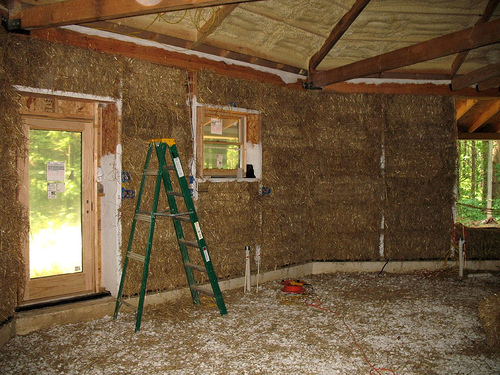
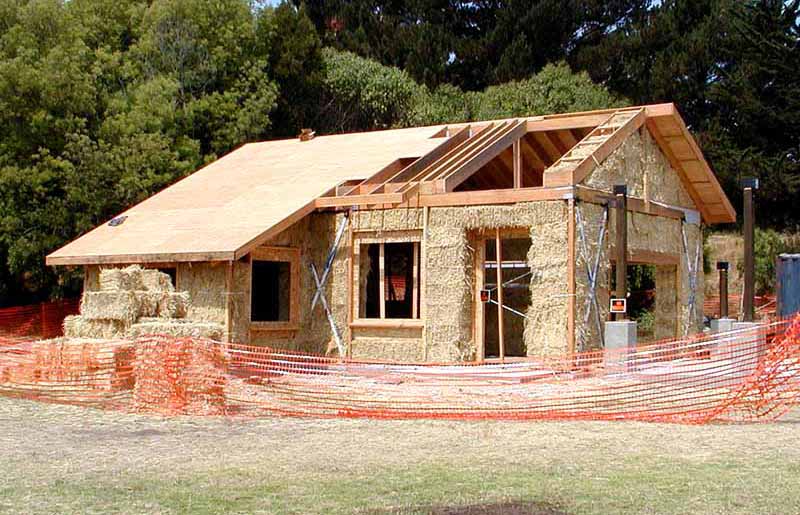
But I think this building technics wich is, about sustainibility, thermic and cost specially , one of the most interesting, and it's just at the beguinning of its reality as a real construction material, I hope that in the coming months/years we will see more experimetation with that material.
More over its really easy to find individuals sites following this kind of self construction initiatives.
By now the major probleme of that technic (straw bale+clay) is that needs a lot of handwork to apply the clay on the straw walls, so if your interested in building one in yourbackyard, you had better to have lot of enthousiastic friends or a big familly!
If you saw a cool straw building let us now we are interesting to publish it on Boiteàoutils !


this one have been designed by HOK ,(found on inhabitat.com more here)lundi 5 janvier 2009
# SELF-CONSTRUCTION /// The air-conditionners of Hyperabad Sind
In Architecture without Architects, Bernard Rudofsky presents this example of a Pakistan city, Hyperabad Sind where a bunch of unique air-conditionners:
jeudi 1 janvier 2009
# SELF-CONSTRUCTION /// Introduction
This month's thematic would be about self-construction.Self-construction always takes place in an interesting debate for the reason it questions the role of the architect. Moreover, it often succeed to achieve an amazing architecture and urbanism in the pureness of a necessary function, to inhabit. Does that mean that the architect could be considered as a luxury supplier, more or less hidden behind a pseudo artistic or intellectual discourse ? It must not be that simple, but beyond the flagellating exercice of the architect of being amazed by architecture without architects, this same architecture ask some real questions about where to stand as an architect.
We will thus try to see a bit clearer during this month.
samedi 6 décembre 2008
# SMALL /// Technocraft's Low tech balloon system
Here is one emergency architecture designed by Technocraft you can find in the book Design like you give a damn (see also a previous post about Concrete massonry units by Sistema Arde).At the site the sewn hemp "skin" are connected by plastic ties and attached to "Life Elements" (doors, windows and faciilities for cooking, sanitation and storage) with a maximum of eight per structure. Workers stuff the hemp strucutre with inflated airbags or balloons, tighten the plastic ties to increase the air pressure, and dampen the entire structure. They then spray or apply mortar over the dome to create a thin concrete shell, much like a papier-maché model. Inner pressure from the airbags supports the structure during the mortar application, making additional construction devices such as an air-compressor or wooden supports unnecessary.
Once the mortar has dried, teams cut out excess hemp from the openings of the doors, windows, and other elements and deflate the airbags, which can be reused. Then workers mortar and plaster the interior walls, creating a waterproof, thermal-insulated shell. Individual units can be easily combined to create larger living spaces.
lundi 6 octobre 2008
# Underworld: what's happening under your feet...
That's Tokyo sewers, it's just incredible!
(it's a old series of photo already publish on a lot of blogs and websites)
IMAGES COPYRIGHT 2005 EDOGAWA RIVER OFFICE, ALL RIGHTS RESERVED.
.jpg)

.jpg)


Those following pictures represent the Montsouris underground water tank in Pais 14th district. its the french version of the undergound cathedral.